
Share Allotment and PAS-3 Filing Under Companies Act 2013: Step-by-Step Procedure
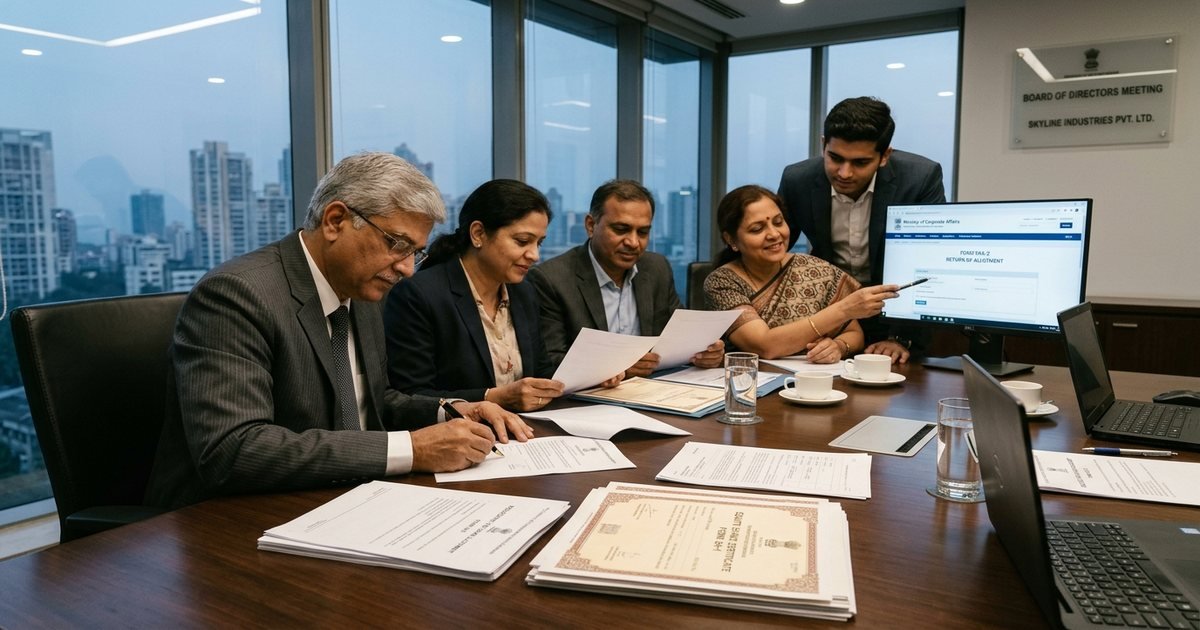
Share allotment under Section 42 (Private Placement) or Section 62 (Rights Issue/Preferential Allotment) of the Companies Act, 2013 is the formal process of issuing new shares to investors or existing members. Key statutory requirements include passing a Special Resolution (filed via Form MGT-14), obtaining a Registered Valuer valuation report for share premiums, receiving subscription money into a separate scheduled bank account, completing share allotment within 60 days of receiving application funds, and filing Form PAS-3 (Return of Allotment) with the ROC within 30 days of allotment. Company funds cannot be utilized until PAS-3 is successfully approved.
Step-by-Step Guide to Share Allotment & PAS-3 Compliance
Raising equity funding—whether from angel investors, seed venture capital funds, or strategic partners—is a defining milestone for startups and private companies. However, issuing equity shares is strictly governed by Section 42, Section 62, and Rule 14 of the Companies (Prospectus and Allotment of Securities) Rules, 2014.
Failing to comply with the statutory sequencing of shareholder approvals, valuation rules, and Form PAS-3 filing can render the allotment void and attract severe penalties of up to the entire amount involved or ₹2 Crores.
Explore our specialized Company Secretarial & Funding Compliance Services.
1. The Statutory Allotment Sequencing Protocol
Executing a private placement share allotment requires following a strict legal order:
- Step 1: Obtain IBBI Valuation Report - Determine the Fair Market Value (FMV) of the equity shares.
- Step 2: Board Meeting - Approve the draft private placement offer letter and issue notice for an Extraordinary General Meeting (EGM).
- Step 3: EGM Approval - Pass a Special Resolution with 75% shareholder majority.
- Step 4: File Form MGT-14 - Submit the Special Resolution to ROC within 30 days of passing it.
- Step 5: Issue Form PAS-4 & Maintain Form PAS-5 - Send private placement offer letters to identified investors and record entries in the register.
- Step 6: Open Separate Scheduled Bank Account - Receive subscription money through banking channels. The 60-day allotment countdown starts upon receipt.
- Step 7: Board Meeting for Allotment - Formally allot shares within 60 days of fund receipt.
- Step 8: File Form PAS-3 - Submit Return of Allotment with the ROC within 30 days of allotment. Funds can only be utilized after filing.
- Step 9: Issue Share Certificates & Remit Stamp Duty - Deliver stamped certificates (Form SH-1) within 2 months.
2. Key Procedural Milestones Explained
Milestone 1: Registered Valuer Report
A private limited company cannot arbitrarily fix its share issue price. An independent valuation report issued by an Insolvency and Bankruptcy Board of India (IBBI) Registered Valuer is mandatory to justify the fair market value (FMV) of the equity shares under both the Companies Act and Rule 11UA of the Income Tax Rules.
Milestone 2: Special Resolution and Form MGT-14
Shareholders must approve the private placement offer via a Special Resolution (75% majority) in an Extraordinary General Meeting (EGM). The company must file Form MGT-14 with the ROC within 30 days of passing the resolution *before* circulating the offer letter.
Milestone 3: Private Placement Offer Letter (PAS-4 & PAS-5)
The company issues a private placement offer letter in Form PAS-4 to identified persons, recording their names in the statutory register in Form PAS-5. The offer cannot be advertised to the general public.
Milestone 4: Separate Scheduled Bank Account
Application money must be paid from the subscriber's bank account via banking channels (cheque, NEFT, RTGS). Cash transactions are strictly forbidden. The company must keep these funds in a dedicated separate bank account and cannot utilize them until Form PAS-3 is submitted to the ROC.
3. Mandatory Attachments for e-Form PAS-3
When filing Form PAS-3 on the MCA V3 portal within 30 days of the allotment board resolution:
- List of Allottees: Certified spreadsheet detailing full name, address, PAN, class of shares, number of shares allotted, nominal value, and premium paid.
- Copy of Special Resolution & Board Resolution: Authorizing the private placement and allotment.
- Valuation Report: Issued by the IBBI Registered Valuer.
- PAS-4 Offer Letter & PAS-5 Register Extracts.
4. Post-Allotment Formalities: Certificates & Stamp Duty
Following successful approval of Form PAS-3:
- Issue of Share Certificates: Deliver physical share certificates (Form SH-1) signed by two directors or credit demat shares within 2 months from the date of allotment under Section 56(4).
- Payment of State Stamp Duty: In Kerala, stamp duty on share certificates must be remitted to the District Treasury / Revenue Department within 30 days of certificate issuance. Failure to stamp certificates renders them inadmissible as evidence in court and attracts heavy penalty interest.
For corporate secretarial support, private placement filings, and valuation advisory, contact D BIZ Secretarial Consultants.
Frequently Asked Questions

Akash P R
Business Consultant10 Years+ Experience in Startup Consultancy, Direct Tax, Indirect Tax and Compliances • D BIZ CONSULTANCY
Business Consultant with 10 Years+ Experience in Startup Consultancy, Direct Tax, Indirect Tax and Compliances.
Connect with Akash on LinkedInOther Strategic Business Guides
GST Registration Documents in Kerala: How to Avoid Application Rejection
8 min readGST & TaxationGSTR-2B Reconciliation with Purchase Register: How to Match Invoices and Protect ITC
9 min readCompany Law & MCAAOC-4 vs MGT-7: Annual MCA Filing Requirements for Indian Companies Explained
8 min readLLP ComplianceLLP Form 8 and Form 11: Annual Compliance Checklist, Timelines and Late Fee Risks
7 min readLatest Regulatory Bulletins
Speak With Our Senior Business Consultants in Trivandrum & Kochi
D BIZ CONSULTANCY PVT. LTD. provides end-to-end company formation, ROC filings, GST accounting, trademark protection, and statutory compliance. Connect with us for personal advisory at our physical offices or 100% paperless digital onboarding.