
GSTR-2B Reconciliation with Purchase Register: How to Match Invoices and Protect ITC
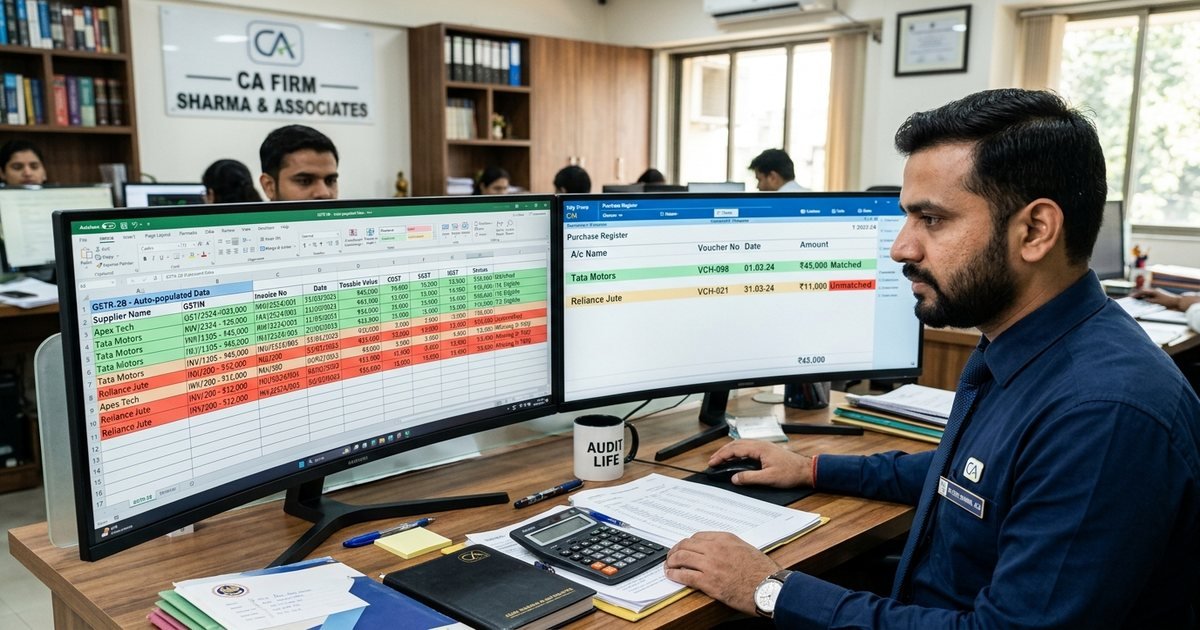
GSTR-2B reconciliation is the process of comparing your internal purchase ledger with the static auto-populated GSTR-2B statement on the GST portal before filing GSTR-3B. Under Section 16(2)(aa) and Rule 36(4), input tax credit (ITC) can only be claimed if the supplier has filed their GSTR-1/IFF and the invoice appears in your GSTR-2B. Claiming ITC outside GSTR-2B triggers automated system notices under Form GST DRC-01B and demands with 18% annual interest.
The Imperative of Monthly GSTR-2B Reconciliation
In India's Goods and Services Tax ecosystem, Input Tax Credit (ITC) is no longer determined simply by possessing a valid tax invoice and recording it in your accounting books. Following amendments to Section 16(2)(aa) of the CGST Act and the omission of provisional credit under Rule 36(4), a taxpayer is legally barred from claiming ITC unless the corresponding supplier has filed Form GSTR-1 / Invoice Furnishing Facility (IFF) and the details appear in the buyer's static Form GSTR-2B.
Failing to reconcile your purchase register against GSTR-2B before filing Form GSTR-3B exposes your business to:
- Disallowance of ITC and demands for tax recovery under Section 73 or 74;
- Mandatory interest liability at 18% per annum under Section 50;
- Automated system-generated scrutiny notices under Form GST DRC-01B;
- Blocking of the electronic credit ledger.
Use our free GSTR-1 to Excel Converter and GSTR Combiner Tool to speed up invoice audits and compliance checks.
1. Comparing GSTR-2A vs GSTR-2B
Understanding the operational boundary between GSTR-2A and GSTR-2B is essential for bookkeeping and audit defense:
| Parameter | GSTR-2A (Dynamic) | GSTR-2B (Static) |
|---|---|---|
| Nature | Dynamic statement; changes continuously whenever a supplier files | Static statement; frozen after generation on the 14th of each month |
| Generation Date | Real-time | 14th of every month (for previous month's transactions) |
| Cut-off Logic | Based on document date | Based on supplier's filing date (e.g., filed between 12th of month M to 11th of month M+1) |
| Legal Basis for GSTR-3B | Historical reference and annual audit reconciliation | Sole legal basis for claiming ITC in Table 4(A) of GSTR-3B |
| Import Data (ICEGATE) | Periodically updated | Contains integrated ICEGATE overseas and SEZ import data |
2. The 5-Step GSTR-2B Reconciliation Protocol
To safeguard cash flow and eliminate compliance risks, finance teams should follow this systematic workflow between the 14th and 18th of every month:
- Step 1: Download GSTR-2B JSON/Excel on 14th - Extract the system-generated statement immediately after it is compiled.
- Step 2: Export Purchase Register from Tally/ERP - Ensure all purchase vouchers, debit notes, and freight bills are entered up to the last day of the preceding month.
- Step 3: Automated Key Matching - Match records using the four primary composite keys: Supplier GSTIN, Document Number, Document Date, and Taxable Value.
- Step 4: Segregate Matches and Discrepancies:
- Exact Matches: Fully matched across GSTIN, Invoice Number, and Tax components. Claim 100% ITC in Table 4(A)(5).
- Available in Books, Missing in GSTR-2B: Supplier has defaulted, delayed filing, or filed under the wrong GSTIN. Do not claim ITC in current GSTR-3B. Move to "ITC Deferred Ledger" and follow up with the vendor.
- Available in GSTR-2B, Missing in Books: Goods in transit, unentered utility bills, or bank charges. Record in books after physical verification of goods/services receipt, then claim ITC.
- Value & Rate Discrepancies: Typographical errors in invoice numbers or decimal variances. Communicate with the vendor for Table 9 amendment in their subsequent GSTR-1.
- Step 5: File GSTR-3B with Confidence - Align Table 4 credit claims precisely with reconciled GSTR-2B values.
3. Handling 180-Day Rule and Supplier Non-Payment
Under the second proviso to Section 16(2), if a recipient fails to pay the supplier the value of the supply plus tax within 180 days from the invoice date, the ITC already claimed must be reversed in Table 4(B)(2) of Form GSTR-3B along with interest under Section 50.
Once the payment is eventually released to the supplier, the reversed ITC can be re-claimed in Table 4(A)(5) without any limitation period.
4. Best Practices for Accounting Teams
- Incorporate a "GST Payment Hold" clause: Withhold 5% to 10% of vendor invoice values until the invoice is confirmed in your GSTR-2B.
- Monthly vendor scoring: Track default rates of key vendors and migrate purchases to compliant suppliers.
- Reconcile RCM Invoices: Ensure reverse charge liability under Section 9(3) is discharged in cash and claimed as ITC within the same tax period.
For comprehensive GST compliance, return preparation, and litigation defense, consult our GST Advisory & Filing Services.
Frequently Asked Questions

Akash P R
Business Consultant10 Years+ Experience in Startup Consultancy, Direct Tax, Indirect Tax and Compliances • D BIZ CONSULTANCY
Business Consultant with 10 Years+ Experience in Startup Consultancy, Direct Tax, Indirect Tax and Compliances.
Connect with Akash on LinkedInOther Strategic Business Guides
GST Registration Documents in Kerala: How to Avoid Application Rejection
8 min readCompany Law & MCAAOC-4 vs MGT-7: Annual MCA Filing Requirements for Indian Companies Explained
8 min readLLP ComplianceLLP Form 8 and Form 11: Annual Compliance Checklist, Timelines and Late Fee Risks
7 min readIncome Tax & AuditTax Audit Applicability Under Section 44AB: Turnover Limits and Presumptive Taxation Rules
9 min readLatest Regulatory Bulletins
Speak With Our Senior Business Consultants in Trivandrum & Kochi
D BIZ CONSULTANCY PVT. LTD. provides end-to-end company formation, ROC filings, GST accounting, trademark protection, and statutory compliance. Connect with us for personal advisory at our physical offices or 100% paperless digital onboarding.