
Choosing Between Private Limited, LLP and Sole Proprietorship: Comparative Guide for Founders in 2026
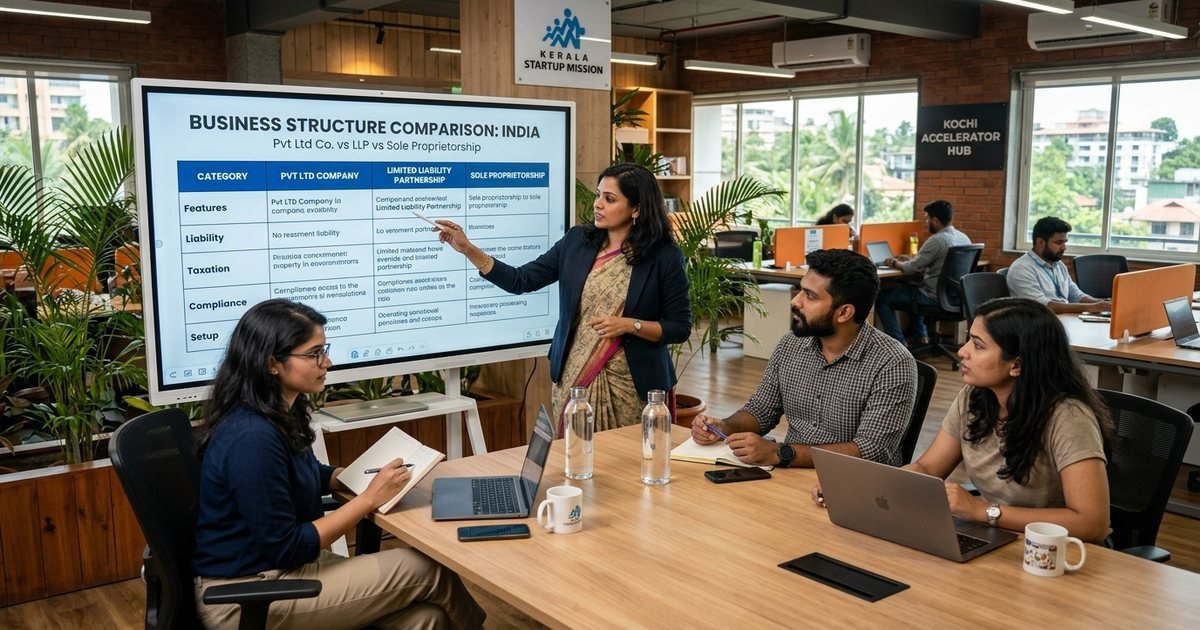
Choosing the right business structure depends on your capital requirements, growth aspirations, risk profile, and compliance budget. A Sole Proprietorship is the simplest and cheapest to start, but carries unlimited personal liability and cannot raise equity funding. An LLP provides limited liability protection and flexible internal management with a flat 30% tax rate, making it ideal for professional services, consulting firms, and bootstrapping ventures. A Private Limited Company is the global benchmark for tech startups, high-growth businesses, and ventures seeking venture capital or angel funding, offering corporate tax rates of 22% (Section 115BAA), ESOPs, and transferable share capital.
Choosing the Ideal Business Structure for Your Venture in 2026
The legal structure you select when incorporating your venture is one of the most critical foundational decisions you will ever make. It dictates your personal legal liability, income tax obligations, corporate governance requirements, annual compliance costs, and whether venture capitalists and banks will fund your business.
Entrepreneurs in Kerala and across India primarily weigh three entity options: Sole Proprietorship, Limited Liability Partnership (LLP), and Private Limited Company.
Explore our business formation services for Starting a Business in Trivandrum, Kochi, Private Limited Company Setup, and LLP Registration.
1. Comprehensive Master Comparison Matrix
| Comparison Parameter | Sole Proprietorship | Limited Liability Partnership (LLP) | Private Limited Company |
|---|---|---|---|
| Governing Law | Common law / Local state laws | Limited Liability Partnership Act, 2008 | Companies Act, 2013 |
| Separate Legal Entity | ❌ No separate legal status | ✅ Yes, distinct corporate body | ✅ Yes, independent corporate juristic person |
| Personal Liability of Owners | 🔴 Unlimited liability (personal assets at risk) | 🟢 Limited to agreed capital contribution | 🟢 Limited to unpaid share capital |
| Minimum Members / Partners | 1 individual | 2 partners (minimum 2 designated partners) | 2 directors / 2 shareholders (1 for OPC) |
| Maximum Limit | 1 individual | No upper limit on partners | Up to 200 shareholders |
| Income Tax Rate | Individual progressive tax slab rates (up to 30% + cess) | Flat 30% (+ surcharge & cess) | 22% (+ 10% surcharge & 4% cess = 25.17%) |
| Tax on Profit Distribution | No additional tax | ✅ Profit share is 100% tax-free (Sec 10(23)) | ❌ Dividends taxed at shareholder's personal slab |
| Statutory Audit Trigger | Only if turnover > ₹1 Cr (or ₹10 Cr digital) | Only if turnover > ₹40L or contribution > ₹25L | Mandatory every year, regardless of turnover |
| Fundraising via Equity / VC | ❌ Impossible | ❌ Highly impractical (no equity shares) | ✅ Gold standard for Angel/VC funding |
| ESOP Issuance | ❌ Not possible | ❌ Not possible | ✅ Can issue Employee Stock Options (ESOPs) |
| Annual Compliance Burden | Minimal (Only personal ITR & GST) | Moderate (Form 11, Form 8, ITR-5) | High (AOC-4, MGT-7, Board Meetings, ITR-6) |
| Estimated Annual ROC Cost | Zero | Low to Moderate | Moderate to High |
2. Deep Dive: When to Choose Each Structure
When to Choose a Sole Proprietorship:
- Micro-scale retail shops, local freelancers, and early-stage solo service providers;
- Ventures with zero commercial debt, low liability exposure, and no external capital requirements;
- When testing a market hypothesis with minimal upfront expenditure before formal corporate registration.
When to Choose a Limited Liability Partnership (LLP):
- Professional services firms (law practices, accounting agencies, architectural studios, consulting businesses);
- Family businesses and closely-held enterprises looking for limited liability protection without the rigid compliance overhead of the Companies Act;
- Bootstrapped ventures planning to distribute operational profits annually to partners without dividend distribution frictions.
When to Choose a Private Limited Company:
- Tech startups, SaaS companies, and ventures intending to raise seed, angel, or institutional venture capital;
- Businesses seeking to incentivize key leadership and engineers through Employee Stock Option Plans (ESOPs);
- B2B enterprises dealing with multinational corporations and government agencies requiring high corporate credibility;
- Promoters planning cross-border expansion, holding company architectures, or eventual initial public offerings (IPO).
3. Strategic Tax Comparison: LLP vs Private Limited
A common dilemma is whether an LLP or a Private Limited company is more tax-efficient:
- Corporate Tax Advantage: Companies enjoy an attractive baseline tax rate of 22% under Section 115BAA compared to 30% for LLPs.
- The Dividend Friction: However, when a company distributes post-tax profits as dividends, the shareholder pays personal income tax at slab rates (up to 35.88% or 39%).
- The LLP Advantage: In contrast, while the LLP pays 30% upfront, the remaining profit can be distributed to partners completely tax-free under Section 10(23) of the Income Tax Act.
- Conclusion: If profits are to be reinvested into expanding company operations, a Private Limited Company is superior. If profits are to be withdrawn annually as personal income for the partners, an LLP frequently delivers higher net post-tax yields.
4. The Path Forward: Getting Started Right
Choosing your business structure is not irreversible. Many successful enterprises start as Sole Proprietorships or LLPs and subsequently convert into Private Limited companies when scaling operations. However, starting with the right structure from Day One eliminates cumbersome asset transfers, stamp duties, and vendor contract novations.
For bespoke incorporation planning, tax modeling, and startup advisory, schedule a consultation with the D BIZ Corporate Setup Desk.
Frequently Asked Questions

Akash P R
Business Consultant10 Years+ Experience in Startup Consultancy, Direct Tax, Indirect Tax and Compliances • D BIZ CONSULTANCY
Business Consultant with 10 Years+ Experience in Startup Consultancy, Direct Tax, Indirect Tax and Compliances.
Connect with Akash on LinkedInOther Strategic Business Guides
GST Registration Documents in Kerala: How to Avoid Application Rejection
8 min readGST & TaxationGSTR-2B Reconciliation with Purchase Register: How to Match Invoices and Protect ITC
9 min readCompany Law & MCAAOC-4 vs MGT-7: Annual MCA Filing Requirements for Indian Companies Explained
8 min readLLP ComplianceLLP Form 8 and Form 11: Annual Compliance Checklist, Timelines and Late Fee Risks
7 min readLatest Regulatory Bulletins
Speak With Our Senior Business Consultants in Trivandrum & Kochi
D BIZ CONSULTANCY PVT. LTD. provides end-to-end company formation, ROC filings, GST accounting, trademark protection, and statutory compliance. Connect with us for personal advisory at our physical offices or 100% paperless digital onboarding.