
Trademark Registration in India: Why Choosing the Wrong Class Can Leave Your Brand Unprotected
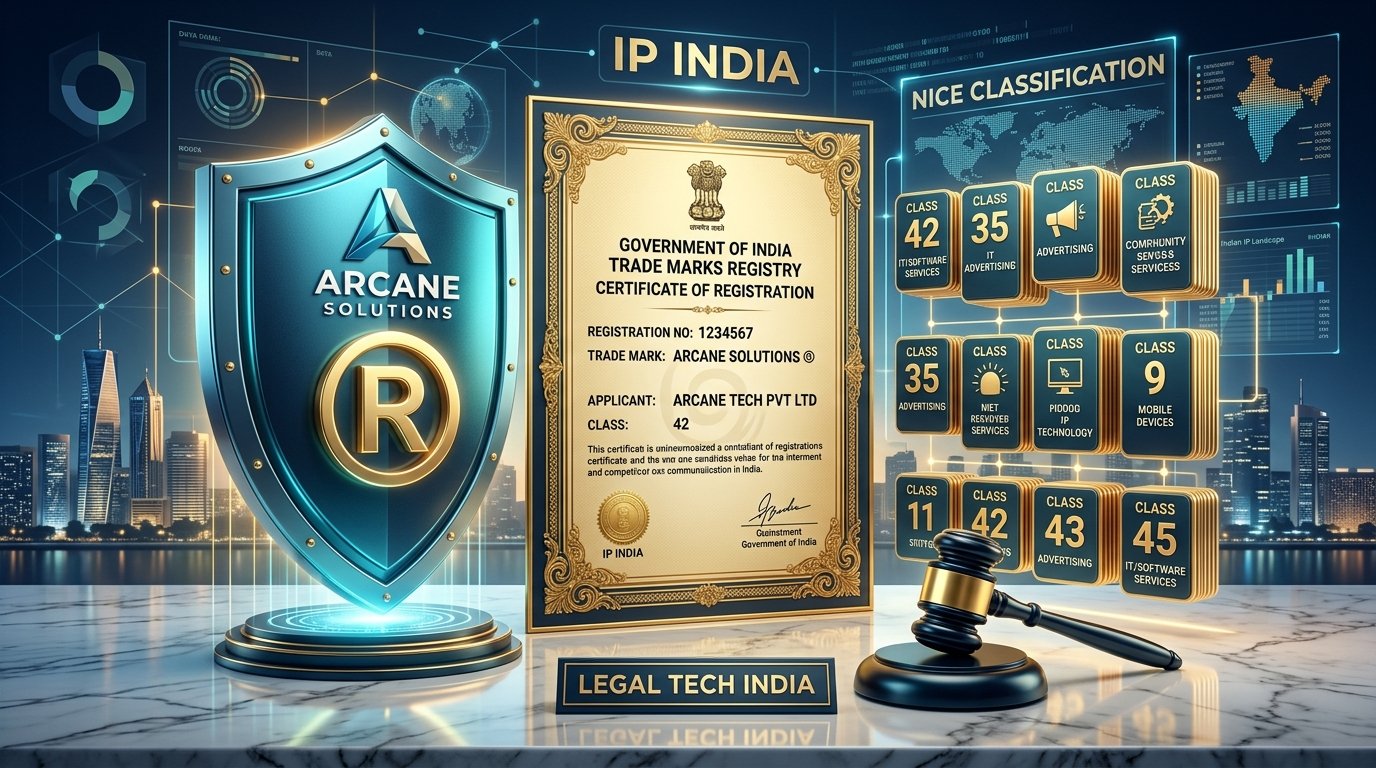
A business owner registers a trademark and assumes: "My brand is protected for everything." Later, another business begins using a similar name for a different activity and the owner discovers that the original trademark application was filed in a class that did not properly cover the business. Trademark protection begins with choosing the correct mark and the correct Nice Classification class.
The Expensive Trademark Illusion
A common and costly blunder among brand owners is assuming that securing a single trademark registration provides absolute, universal brand immunity across all commercial domains.
Consider this actual commercial scenario:
An entrepreneur launches a premium apparel brand named "ZEPHYR" and registers the trademark under Class 25 (clothing and footwear).
Two years later, another company opens an online retail marketplace named "ZEPHYR" selling fashion accessories under Class 35 (retail store services and e-commerce platforms).
Can the clothing manufacturer stop the online marketplace?
Often, no—because the original trademark was filed strictly for manufactured garments under Class 25, completely omitting retail and commercial service activities under Class 35.
Trademark protection in India is fundamentally class-specific. Choosing the wrong class or failing to register across all operational verticals leaves your brand exposed to legal encroachment.
What Is a Trademark?
Under the Trade Marks Act, 1999, a trademark is a visual or sensory brand identifier capable of being represented graphically and distinguishing the goods or services of one enterprise from those of others.
Eligible brand assets include:
- Brand names and coined business titles;
- Stylized brand logos and emblems;
- Catchy advertising taglines and slogans;
- Product packaging and distinctive shapes of goods; and
- Unique color combinations or sound marks.
Step 1: Conduct an Exhaustive Clearance Search Before Filing
IP India's trademark workflow begins with checking brand availability before filing Form TM-A.
A casual Google or domain-name search does not constitute a trademark clearance search. A proper statutory search on the official IP India Trade Marks Database must investigate:
- Phonetic Similarity: Marks that sound identical despite different spelling (e.g., *"Klin"* vs. *"Clean"*, or *"Pharma"* vs. *"Farma"*);
- Visual Similarity: Logos or lettering styles resembling existing registered or pending marks;
- Translation / Conceptual Similarity: Words conveying identical conceptual meaning in other languages; and
- Cross-Class Clashes: Similar marks in closely associated goods or service classes.
Step 2: The Nice Classification System (Classes 1 to 45)
India follows the international Nice Classification system, comprising 45 distinct classes:
- Classes 1 to 34: Goods and manufactured physical products; and
- Classes 35 to 45: Services and commercial activities.
#### Why a Modern Business Usually Needs Multiple Classes:
Suppose an organic cosmetic enterprise operates under the brand name "AURA":
- Class 3: Skincare creams, herbal soaps, and cosmetic products (Goods);
- Class 35: Retail outlets, wholesale distribution, and direct-to-consumer e-commerce portal (Services); and
- Class 44: Beauty salons, wellness clinics, and therapeutic spa services (Services).
Filing exclusively under Class 3 leaves the brand's retail presence and salon chain legally vulnerable.
Step 3: Word Mark vs. Device Logo: Which Should You File?
- Word Mark: Protects the text, word, or name itself, irrespective of font style, size, casing, or visual representation. A word mark offers the strongest and broadest legal protection because competitors cannot use the word even in a completely different font or color.
- Device / Logo Mark: Protects the exact graphical depiction, typography, layout, and visual emblem as filed in the application.
Strategic Recommendation: If budget permits, start by registering the Word Mark to secure absolute name monopoly. Follow up by registering the Device/Logo Mark to protect your distinct graphical identity.
Step 4: Proposed to Be Used vs. Claiming Prior Use
Under Indian trademark law, an application can be filed either:
- On a "Proposed to Be Used" Basis: For new businesses or brands that have not yet launched commercially; or
- Claiming Prior Commercial Use: If the brand has already been in continuous commercial use in India.
When claiming prior use, you must submit a User Affidavit accompanied by documentary evidence (such as dated tax invoices, media advertisements, domain registration receipts, or social media records proving the earliest date of commercial usage). Casually inserting an arbitrary past date without documentary backing can lead to immediate objection or invalidation during opposition proceedings.
Step 5: Statutory Government Fees for Form TM-A
The Trade Marks Registry provides substantial government fee subsidies for individuals and small businesses:
- Individuals, Startups (DPIIT Recognized), and Small Enterprises (Udyam MSME): ₹4,500 per class per mark for online e-filing;
- All Other Entities (Large Enterprises, Non-MSME Companies, Partnerships): ₹9,000 per class per mark.
Professional drafting, objection representation, and hearing appearance fees are separate from statutory filing fees.
The Trademark Registration Lifecycle in India
- Filing Form TM-A: Immediate generation of the Trademark Application Number. The applicant can start using the ™ symbol;
- Formalities Chk Pass: Verification of basic documents, classification, and power of attorney;
- Examination by Trade Marks Registry: The examiner inspects the application for absolute grounds of refusal (Section 9 - descriptive or generic terms) and relative grounds (Section 11 - similarity to prior marks);
- Examination Report / Objection: If an objection is raised, a formal legal response must be drafted and submitted within 30 days;
- Show Cause Hearing: If the examiner is not fully satisfied with the written response, an online hearing is scheduled;
- Publication in the Trade Marks Journal: Once accepted, the mark is advertised in the weekly Trade Marks Journal for 4 months to allow third-party opposition; and
- Issuance of Registration Certificate: If no opposition is filed (or opposition is decided in favor of the applicant), the registration certificate is issued. The owner can now display the prestigious ® symbol.
A registered trademark is valid for 10 years from the date of application and can be renewed indefinitely every 10 years upon payment of renewal fees.
Frequently Asked Questions

Akash P R
Author & Business ConsultantBusiness Consultant at D BIZ CONSULTANCY
Business consultant and corporate advisor specializing in company incorporation, MCA/ROC statutory compliance, GST advisory, trademark protection, and cross-border structuring across Kerala and India.
Connect with Akash on LinkedInAkash P R
Business & Legal Consultant
D BIZ CONSULTANCY PVT. LTD.
Planning company incorporation, trademark filing, or tax compliance? Speak directly with our consultant:
Springs Tower, Edappazhanji / Paruthippara, Trivandrum.
Plus Code: GX39+M6 Thiruvananthapuram, Keralam
Koprambil Heights, Seaport-Airport Rd, Irumpanam, Thrippunithura, Kochi.
Other Strategic Guides
Private Limited Company Registration in India: 10 Common Mistakes That Can Delay Your Incorporation
7 min readCompliance & AuditCompany Registered – What Next? Essential Compliances During the First 180 Days
6 min readCompliance & AuditPrivate Limited Company Annual Compliance in India: A Practical Checklist for Business Owners
6 min readCompany Law & MCAStarting an Indian Company With a Foreign Shareholder: Incorporation, FEMA and FC-GPR Explained
7 min readLatest Regulatory Bulletins
Tax Audit Report Due Date Extended to 21 October 2026 and ITR to 21 November 2026 for AY 2026-27
28 SeptTax & GSTGSTN Introduces emSigner Version 3.3 for New Digital Signature Certificate (DSC) USB Tokens
27 SeptTrademarks & IPIP India Sets 30 September 2026 as Final Deadline for Mandatory e-KYC Compliance
26 SeptSpeak With Our Senior Business Consultants in Trivandrum & Kochi
D BIZ CONSULTANCY PVT. LTD. provides end-to-end company formation, ROC filings, GST accounting, trademark protection, and statutory compliance. Connect with us for personal advisory at our physical offices or 100% paperless digital onboarding.