
RBI Repo Rate Rises to 5.50% in October 2026: Impact on Business Loans and Kerala MSMEs
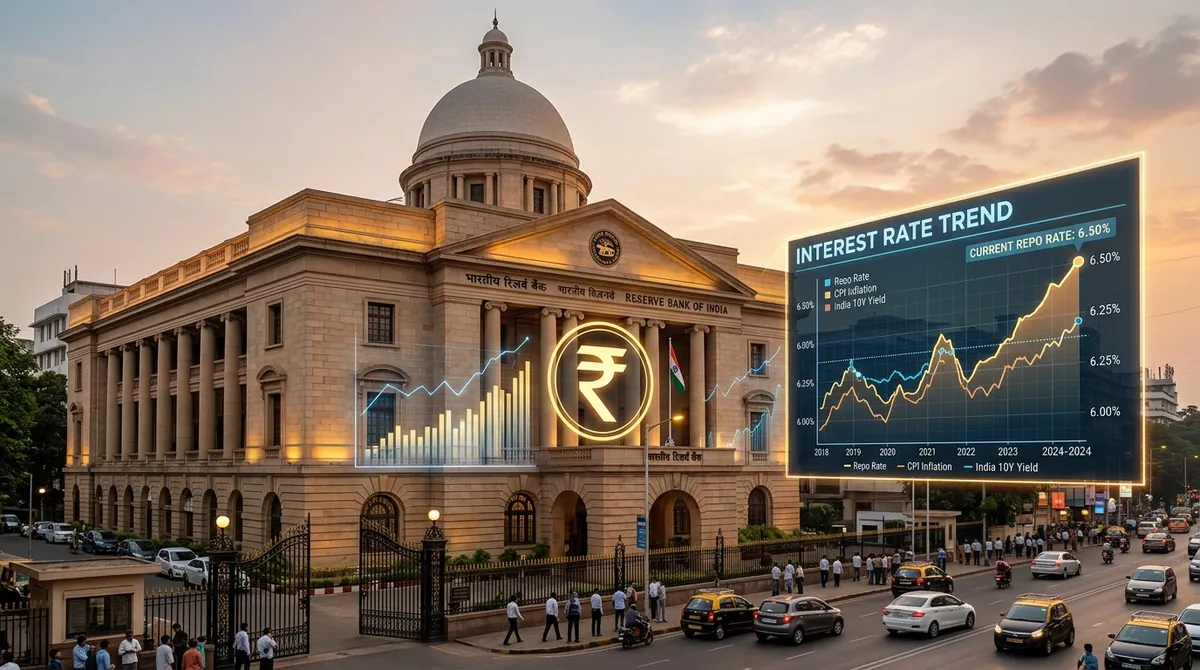
The Reserve Bank of India’s Monetary Policy Committee (MPC) raised the benchmark repo rate by 25 basis points to 5.50% on 7 October 2026, shifting its monetary stance to calibrated tightening. Because commercial bank lending rates for MSMEs are pegged directly to external benchmarks (EBLR/RLLR), businesses with floating-rate borrowings will experience an immediate increase in borrowing costs. Enterprises in Kerala must review loan agreements, optimize working capital cycles, and recalibrate financial project projections.
Published Date: 7 October 2026
Reviewed by: Akash P R, Business Consultant & Senior Corporate Advisor, D BIZ CONSULTANCY PVT. LTD.
Monetary Policy Action & Macroeconomic Backdrop
In response to persistent inflationary pressures and evolving domestic demand indicators, the Reserve Bank of India's (RBI) Monetary Policy Committee (MPC) announced an increase in the benchmark policy repo rate by 25 basis points to 5.50% on 7 October 2026. Concurrently, the central bank revised its monetary stance from neutral to calibrated tightening, signaling an emphasis on price stability and disciplined credit expansion.
Key Policy Changes at a Glance
| Monetary Parameter | Previous Rate | New Rate (Oct 2026) | Change |
|---|---|---|---|
| Policy Repo Rate | 5.25% | 5.50% | +25 bps |
| Standing Deposit Facility (SDF) | 5.00% | 5.25% | +25 bps |
| Marginal Standing Facility (MSF) | 5.50% | 5.75% | +25 bps |
| Monetary Policy Stance | Neutral | Calibrated Tightening | Shift |
| Direct Impacted Facility | External Benchmark Lending Rate (EBLR) linked loans | Immediate rate revision |
How Does This Affect Businesses in Kerala?
For micro, small, and medium enterprises (MSMEs) and corporate borrowers across Thiruvananthapuram, Kochi, Kozhikode, and Ernakulam, interest rate revisions translate rapidly into real financial impacts:
1. Automatic Escalation in Floating Borrowing Costs
Under RBI mandates, all floating-rate loans sanctioned to MSMEs by commercial banks must be tied to an external benchmark—predominantly the RBI Repo Rate (External Benchmark Based Lending Rate or EBLR). Consequently:
- Interest rates on existing working capital facilities, Cash Credit (CC) limits, and commercial vehicle loans will rise by approximately 25 basis points.
- Term loans will either experience an increase in monthly EMI installments or an extension in total loan tenure.
2. Squeeze on Operating Margins and Cash Flows
Manufacturing and trading businesses with substantial debt exposure will experience higher debt servicing charges, compressing net profit margins. In high-turnover, low-margin sectors (such as consumer retail, spice exports, and wholesale distribution in Kerala), finance costs can significantly affect liquidity.
3. Review of Capital Expenditure (CapEx) Feasibility
Entrepreneurs evaluating new factory setups, machinery acquisitions, or office expansions must recalculate their Internal Rate of Return (IRR) and Debt Service Coverage Ratio (DSCR) under the revised interest regime.
Action Plan for Business Borrowers: 4 Strategic Steps
To mitigate the impact of higher interest rates, business leadership should implement targeted financial adjustments:
- Audit Existing Loan Covenants: Review loan sanction letters to confirm whether existing borrowings are on EBLR, MCLR, or fixed terms.
- Accelerate Working Capital Collections: Shorten customer credit periods and aggressively follow up on outstanding receivables to minimize reliance on high-cost overdraft limits.
- Explore Debt Restructuring or Refinancing: Evaluate transferring high-interest business borrowings to institutions offering lower spreads over benchmark rates.
- Prepare Robust Financial Project Reports: When applying for new bank lines, present detailed CMA data that demonstrates adequate debt-servicing buffers.
How D BIZ Consultancy Assists Borrowers
D BIZ CONSULTANCY PVT. LTD. provides comprehensive financial modeling, credit appraisal assistance, and statutory advisory services to businesses navigating changing credit environments.
Related Advisory Services:
- Bankable Project Reports & CMA Data Preparation for Loans
- Government Loan Schemes Guidance (PMEGP, Stand-Up India, Mudra)
- Corporate Financial Health Audit & TDS Compliance
- Statutory Compliance & ROC Filings for Companies
Speak With Our Financial Advisory Specialists:
Phone: +91 8075273408 | Vazhuthacaud, Thiruvananthapuram & Irumpanam, Kochi
Frequently Asked Questions
Practical answers to common business questions regarding this statutory update.

Akash P R
Business & Legal Consultant
D BIZ CONSULTANCY PVT. LTD.
Have questions about this compliance update or require assistance with filing before the due date? Connect directly with our advisory desk:
TC No 44, 913, Cotton Hill Rd, Cotton Hill, Vazhuthacaud, Trivandrum 695014.
Plus Code: GX39+M6 Thiruvananthapuram, Keralam
Koprambil Heights, Seaport-Airport Rd, Irumpanam, Thrippunithura, Kochi.
Other Regulatory Bulletins
GST Collections Reach ₹2.04 Lakh Crore in September 2026: What Businesses Should Know
1 OctStartup & MSMEKerala Government Backs Women Entrepreneurs and Social Startups at Trivandrum Conclave
1 OctInfrastructure & TechnologyKerala Space Park Project at Technocity, Trivandrum Set to Resume Construction
2 OctInvestment & Life SciencesBio Connect 4.0 in Trivandrum to Showcase Kerala's Life Sciences Investment Opportunities
3 OctInfrastructure & ITTechnopark Phase III Expansion: New 2 Lakh Sq. Ft. IT Building Planned in Trivandrum
5 OctAvoid Penalties Under Income Tax & MCA with D BIZ
Whether you require Tax Audit Form 3CA/3CB filing by 21 October, Corporate ITR filing by 21 November, or AGM and DIR-3 KYC compliance, our multi-disciplinary team in Thiruvananthapuram and Ernakulam guarantees timely execution.