
Private Limited Company Annual Compliance in India: A Practical Checklist for Business Owners
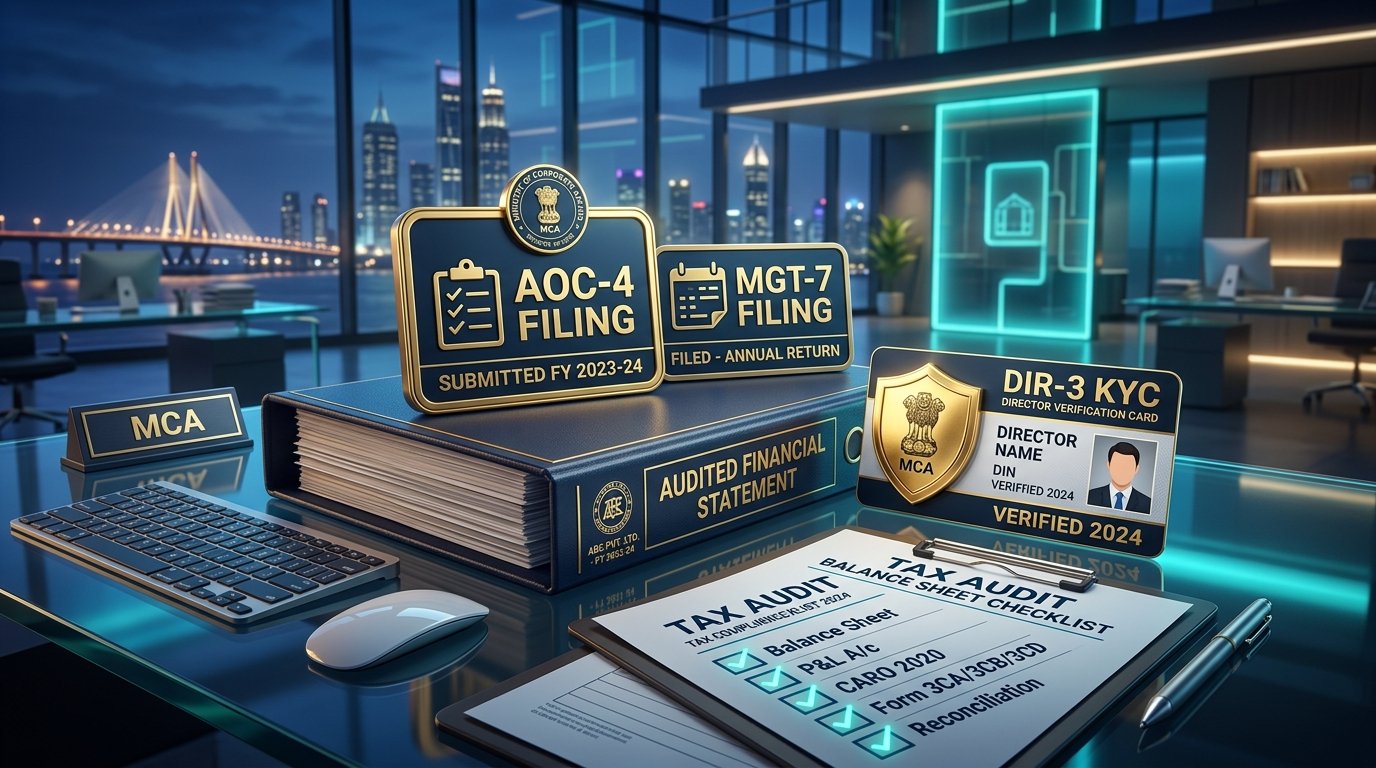
Many business owners believe annual company compliance means filing one return with MCA. It does not. Annual compliance is a combination of accounting, statutory audit, corporate approvals, financial statements, annual ROC filings, income-tax compliance, and event-based filings arising during the year.
The Common Misconception About Annual Compliance
A widespread misconception among startup founders is that annual company compliance consists simply of uploading a single tax form once a year.
In reality, corporate compliance under the Companies Act, 2013 is an integrated ecosystem comprising:
- Continuous monthly double-entry accounting;
- Independent statutory audit by a chartered accountant;
- Formal board meetings and Annual General Meetings (AGM);
- Filing audited financial statements (Form AOC-4);
- Filing the statutory annual return (Form MGT-7 / MGT-7A);
- Corporate income tax return filing (ITR-6); and
- Timely reporting of corporate events as they happen throughout the financial year.
What Records Must a Company Maintain Throughout the Year?
A well-administered enterprise should systematically maintain and reconcile:
- Updated books of accounts (general ledgers, cash books, journals);
- Monthly bank reconciliation statements (BRS);
- Purchase and sales registers matching GST filings;
- Fixed asset registers with depreciation calculations;
- Loan balances and interest schedules;
- Related-party transaction disclosures under Section 188;
- Statutory registers of members, directors, and share transfers; and
- Supporting invoices, contracts, and vendor vouchers.
Postponing bookkeeping until the annual filing window increases costs, causes accounting errors, and risks missing statutory MCA deadlines.
The Statutory Audit Framework
Under the Companies Act, every Private Limited Company—regardless of its size, capital, or operational turnover—must have its annual accounts audited by an independent statutory auditor.
The statutory auditor examines:
- Bank balances and cash flow statements;
- Valuation and physical existence of assets and liabilities;
- Director loans and unsecured borrowings;
- Compliance with Accounting Standards (AS / Ind AS);
- Revenue recognition and proper expense categorization; and
- Statutory dues payment proofs (GST, TDS, EPF, ESI).
The auditor issues an Audit Report outlining an independent opinion on whether the financial statements present a true and fair view of the company's financial state.
Annual General Meeting (AGM) Requirements
Every company must convene an Annual General Meeting (AGM) of its shareholders each calendar year.
- Timing: Held within 6 months from the close of the financial year (on or before September 30th for companies following the April–March financial year).
- Ordinary Business: Consideration of financial statements and the board's report, declaration of dividends, and appointment/ratification of statutory auditors.
- Minutes and Records: Proper notices (giving 21 clear days' notice unless shorter notice is consented to), resolutions, and signed AGM minutes must be preserved in the statutory minute book.
Filing Financial Statements – Form AOC-4
Under Section 137, a company must file its audited financial statements with the ROC via Form AOC-4 (or AOC-4 XBRL for eligible classes) within 30 days of holding its AGM (normally on or before October 30th).
Before submitting AOC-4, ensure absolute consistency across:
- Audited balance sheet and profit & loss statements;
- Notes to accounts and auditor's report;
- Board of Directors' Report; and
- Accounting software master data.
Filing Annual Return – Form MGT-7 / MGT-7A
Under Section 92, every company must file its annual return in Form MGT-7 (or Form MGT-7A for One Person Companies and Small Companies) within 60 days of the AGM (typically on or before November 29th).
Form MGT-7 captures:
- Registered office location and principal business operations;
- Indebtedness and charges on assets;
- Shareholding pattern and changes in promoter equity;
- Details of directors, key managerial personnel, and board meetings held; and
- Director remuneration and attendance records.
Event-Based Compliance: Where Many Businesses Fail
Annual filings do not cure or regularize corporate transactions that should have been reported immediately when they occurred.
Common event-based filings include:
- Form DIR-12: Appointment or resignation of a director (within 30 days);
- Form INC-22: Change of registered office address (within 30 days);
- Form PAS-3: Allotment of equity or preference shares;
- Form SH-7: Increase in authorized share capital;
- Form CHG-1 / CHG-4: Creation, modification, or satisfaction of bank charges; and
- Form MGT-14: Filing of special resolutions passed by shareholders.
Practical Example: If a company brings in an angel investor in June and issues new equity shares, it must complete board approvals, shareholder sanctions, and file Form PAS-3 within statutory timelines. Waiting until the following year's annual return will attract heavy late-filing fees and severe MCA notices.
Director KYC – Form DIR-3 KYC
Every individual holding a Director Identification Number (DIN) must complete their annual Director KYC via Form DIR-3 KYC (or web-service authentication) on or before September 30th every year. Failure to file DIR-3 KYC deactivates the DIN, disqualifying the director from signing any corporate forms across all directorships, accompanied by a ₹5,000 reactivation penalty.
The Monthly Compliance Review Protocol
Even for early-stage companies with moderate transactional volume, management should conduct a brief monthly compliance review covering:
- New commercial contracts and vendor commitments;
- Loans taken or extended;
- Changes in director or shareholding structure;
- Bank reconciliations and tax deductibles (TDS & GST);
- Statutory tax deposits; and
- Pending MCA / ROC filings.
Frequently Asked Questions

Akash P R
Author & Business ConsultantBusiness Consultant at D BIZ CONSULTANCY
Business consultant and corporate advisor specializing in company incorporation, MCA/ROC statutory compliance, GST advisory, trademark protection, and cross-border structuring across Kerala and India.
Connect with Akash on LinkedInAkash P R
Business & Legal Consultant
D BIZ CONSULTANCY PVT. LTD.
Planning company incorporation, trademark filing, or tax compliance? Speak directly with our consultant:
Springs Tower, Edappazhanji / Paruthippara, Trivandrum.
Plus Code: GX39+M6 Thiruvananthapuram, Keralam
Koprambil Heights, Seaport-Airport Rd, Irumpanam, Thrippunithura, Kochi.
Other Strategic Guides
Private Limited Company Registration in India: 10 Common Mistakes That Can Delay Your Incorporation
7 min readCompliance & AuditCompany Registered – What Next? Essential Compliances During the First 180 Days
6 min readCompany Law & MCAStarting an Indian Company With a Foreign Shareholder: Incorporation, FEMA and FC-GPR Explained
7 min readGST & TaxationGST Registration in India: When Is It Compulsory and When Should You Avoid Registering Too Early?
6 min readLatest Regulatory Bulletins
Tax Audit Report Due Date Extended to 21 October 2026 and ITR to 21 November 2026 for AY 2026-27
28 SeptTax & GSTGSTN Introduces emSigner Version 3.3 for New Digital Signature Certificate (DSC) USB Tokens
27 SeptTrademarks & IPIP India Sets 30 September 2026 as Final Deadline for Mandatory e-KYC Compliance
26 SeptSpeak With Our Senior Business Consultants in Trivandrum & Kochi
D BIZ CONSULTANCY PVT. LTD. provides end-to-end company formation, ROC filings, GST accounting, trademark protection, and statutory compliance. Connect with us for personal advisory at our physical offices or 100% paperless digital onboarding.